
Waveguides and Devices
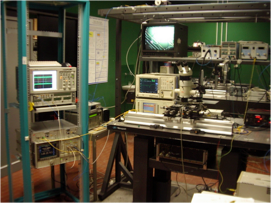
Three PC assisted setup for waveguide characterization with three tunable lasers at wavelength 1.3 and 1.5 μm, two Optical Spectrum Analyzers, EDFA amplifiers, polarization controllers and polarization scramblers, polarimeter, power meters, visible and IR camera. Each setup is equipped with a microscope and micro- and nano- positioners for fiber and objective coupling, Peltier with thermo-electric controller and PC. Two setup are suitable for coupling with nano-waveguides (SOI), one for medium and large core waveguides.

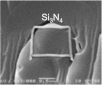
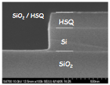

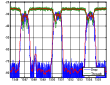
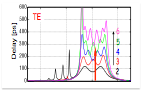
Almost every characterization is possible: spectral resolved attenuation and insertion loss, coupling efficiency, effective index, group index and chromatic dispersion, birefringence and space resolved birefringence, near field and refractive index reconstruction, back-scattering and polarization conversion, PDL and PMD. These characterization techniques have been tested on Ge:SiO2, SiON, Si3N4, TeO2, LiNbO3, InP, Chalcogenide, Silicon (SOI), Photonic Chrystal and Multimode waveguides.
In the nonlinear domain typical characterizations include nonlinear absorption (TPA/FCA), spectral broadening, XPM and four wave mixing. In the wavelength range 1.52-1.56 μm a 27 dBm of average power is available (CW) with a maximum of 30W of peak power in case of pulses (repetition rate 1 KHz).
Optical Low Coherence Interferometry
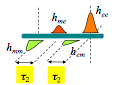
A fully automated Phase Sensitive Low Coherence Interferometric setup for waveguides and devices characterization (tomography), complex spectral response (magnitude and group delay), “defectology” is available. This setup is used with proprietary software routines for parameters extraction, tuning of integrated optical filters and “virtual” pulse propagation. Characterization in both transmission and reflection are possible.
The acquired signal is processed according to a patented signal processing technique that increases the accuracy of the measured phase down to 0.01 rad (few nanometers) and simplify the optical setup and the acquisition system.
Wavelength range: 1510nm – 1600nm (2 SLD)
Resolution: 30 μm
Dynamic: 80 dB
Polarization sensitive: TE,TM, polarization rotation
Accuracy: group index (±2e−5), birefringence (±2e−5), chromatic dispersion (±2e−5), phase (0.01 rad)
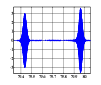
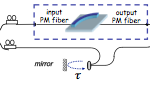
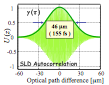
Read more on: C. Canavesi, F. Morichetti, A. Canciamilla, A. Melloni, and M. Martinelli, “A Novel Phase- and Polarization-Sensitive Scheme for Optical Low-Coherence Interferometry,” Journal of Lightwave Technology, October 2009. A. Melloni, C. Canavesi, F. Persia, “Apparato di interferometria a bassa coerenza sensibile alla fase”, Italian Patent MI2006A001792, 21 September 2006.
Time Domain Characterization
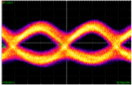
A PRBS signal generator, phase and intensity modulators, a sampling oscilloscope and a clock recovery up to 10 Gbit/s allow a full time domain characterization of integrated optical devices. DPSK, DQPSK and polarization multiplexed signals are available as well. EDFA amplifiers, two fast detectors and more than 200 km of standard optical fiber (SMF 28) permit accurate and realistic transmission experiments.
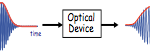
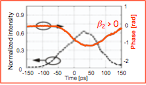
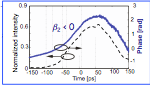
In addition, a unique virtual probe pulse technique is available for devices characterization in time domain. The envelope and the phase, that is the chirp, of single pulses propagating through devices can be accurately analyzed. Pulses from 1 ps to 500 ps offers the most accurate characterization conditions.
The technique has been used to detect superluminal effects in integrated optical ring resonators.
Read more on:
F. Morichetti, A. Melloni, and M. Martinelli, “Optical Pulse Coherence Interferometry: shaping probe pulses in time domain interferometry”, Optics Letters, vol. 15, no. 10, 1123-1125, May 2008. A. Melloni, F. Morichetti, “Direct Observation of Subluminal and Superluminal Velocity Swinging in Coupled Mode Optical Propagation”, Phys. Rev. Lett. 98, 173902 (2007)Frequency Domain Reflectometry
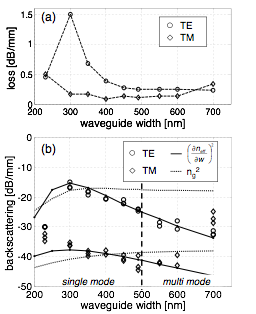 A powerful processing of the signal back-reflected from waveguides and devices allows to recover both the amplitude and phase of the distributed backscatter and localized reflections with a spatial resolution of tenths of micrometers. We used this technique to measure quantitatively the distributed backscatter of integrated optical waveguides in different technologies, included Photonic Crystals waveguides.
Results concerning SOI waveguides have been published on Physical Review Letters, Optics Letters and Applied Physics Letters. Figures show losses and backscatter of a 220 nm thick SOI waveguides and the fitting with our model.
The same characterizations have been performed on Ge:SiO2, SiON, Triplex, InP and As2S3 waveguides.
Read more on:
F. Morichetti, A. Canciamilla, M. Martinelli, A. Samarelli, R. M. De La Rue, M. Sorel, and A. Melloni, “Coherent backscattering in optical microring resonators,” Appl. Phys. Lett. 96, 081112 (2010). F. Morichetti, A. Canciamilla, C. Ferrari, M. Torregiani, A. Melloni, and M. Martinelli, “Roughness Induced Backscattering in Optical Silicon Waveguides,” Phys. Rev. Lett. 104, 033902 (2010). F. Morichetti, A. Canciamilla, and A. Melloni, “Statistics of backscattering in optical waveguides,” Opt. Lett. 35, 1777-1779 (2010).